
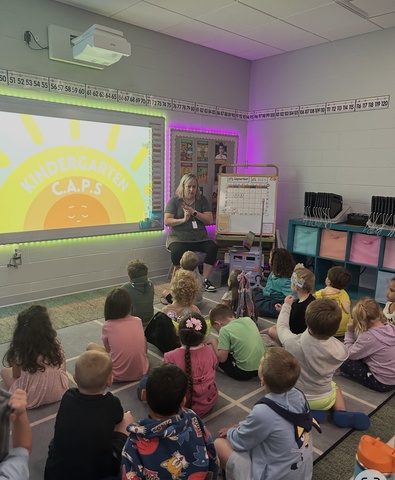
Kelli Johnson, school counselor at Parkview Elementary (Marion Independent School District, Iowa), values each interaction she has with her students. Small but powerful actions, such as genuinely showing interest in each student’s life, being an active listener, her signature “Counselor Mail” activity, and proactive outreach to parents/families, have combined to make a big difference in her school community--making Kelli a deserving honoree of the February 2026 Iowa School Mental Health Hero of the Month award.
Kelli’s journey to school counseling began with inspirational role models—the middle school and high school counselors she herself had growing up. Her role models not only taught her the significance of school staff-student relationships but also showed her how school counselors positively contribute to a student’s overall support system. (In fact, her relationships with her school counselors were so influential that she still remains in contact with them!) Now, throughout her 13 years as a school counselor (8th year in her current role), Kelli’s relationship-first approach has fostered a culture of mental health and well-being across the district.
“Kelli is always going above and beyond for her students and staff,” says Rachel Zaruba, fellow school counselor at Longfellow Elementary. “She provides staff with instructions on how to best address students' mental health in their classrooms, and is incredibly creative and flexible with her lessons to meet the mental health and social-emotional needs of her students.”
Some of Kelli’s favorite resources lean into building empathy, emotional vocabulary, and self-regulation. When guiding classroom conversations and small groups, she often teaches students to identify feelings, use coping strategies, and build understanding that different students need different levels of support.
Her dedication to expanding mental health resources is also notable. She has written several grants to establish a social-emotional library. The library now has more than 500 books on a range of topics that teachers can access, or on which Kelli teams up with teachers to create a targeted lesson for their classrooms.
Additionally, Kelli is passionate about connecting students to school mental health services, especially for those whose family situations make it difficult for students to get mental health support outside of school hours. When a student may need a mental health referral, she partners with Tanager Place to arrange an on-site mental health provider at the school or leverages the online referral platform Care Solace to help families find the right providers, schedules, and services for their child.
Recognizing the importance of strong school-home relationships, Kelli extends mental health education and awareness to parents/caregivers. Most often, she does this by calling a student’s parent to talk through concerns and validate their experiences. To equip parents with practical tools they can use at home, she shares short cheat sheets with quick tips and strategies for addressing youth anxiety and ADHD. One best practice she often encourages is for families to go around the room and share one kind thing they did that day or something kind they saw someone else do.
“At the foundation of all this is relationship-building with students. Knowing their names, greeting them, checking in, and making sure they feel seen. Those everyday connections create the trust that makes all other support more effective,” says Kelli.
Systems anchor Kelli’s work. She has taken a leadership role in developing a comprehensive MTSS (Multi-Tiered System of Supports) framework and collaborates across grade-level Professional Learning Communities to emphasize that a mental health mindset is essential for students to become 21st-century learners, working closely with teachers, paraprofessionals, behavior strategists, and the principal to develop strategies and use data to help students. For example, a recent data review found that many behavior referrals came from students who were being defiant, shutting down, or refusing to do work. When the team dug deeper, they realized that a lot of the behavior was tied to avoidance (e.g., students not knowing how to do something that felt hard or not feeling safe enough to try and possibly make a mistake).
From this staff collaboration, Kelli wrote "Push Through Power,” a four-step, structured lesson plan. When students practice those steps, they earn a small sticker, which helps build confidence and normalize working through hard things. Teachers now use that lesson weekly.
For her undergraduate studies, Kelli attended the University of Dubuque, where she studied psychology and criminal justice. She then earned her master’s in School Counseling at the University of Northern Iowa. Always learning and growing in her role, Kelli also recently earned her Licensed Mental Health Counselor (LMHC) certification. This has helped Kelli deepen her mental health knowledge, better relate towhat kids are going through, and better understand how to get students the right kind of help. In 2023, Kelli was recognized as the 2023 Iowa School Counselor of the Year by the Iowa School Counselor Association (ISCA).
How Kelli Establishes a Positive Mental Health Culture
Read Kelli’s insights and tips in the Q&A below.
How do you build trust with students—especially young learners—so they feel safe, supported, and willing to seek help?
During the elementary years, building trust is very intentional. I start every year by teaching students what a school counselor is and reassuring them they're never in trouble when they're with me. I also ensurethey understand where my office is and that they can see me at any time.
That's very important to me because there have been several instances where a student may not be considered at risk, but something in their life might have changed, and they might need my support. So if they already know who I am and what I do, they know they can trust me. It makes it a lot easier for them to want to open up or to take the mental health breaks that they might need during the day to get some extra support.
One thing that I do that I think has helped a lot is knowing all my students' names. I also do “Counselor Mail.” Every time I visit their classroom, I bring “Counselor Mail,” a handwritten note for a student. They arealways wondering whether it's their turn to get it. I try my best to write something personal, like something I may have seen them do, or just tell them that I'm glad they're here, or I'm proud of them, or that they make Parkview a better place. I think kids just need to hear more often that they're seen and important.
You place relationships and mental health at the forefront of your work. How does that philosophy influence the decisions you make in your school community?
Building strong relationships with families provides valuable insight into diverse situations and their potential impact on students' lives. Understanding what students may be experiencing outside of school helps to guide the decisions I make within the school setting.
One example is a student who may have witnessed things at home and may be more easily triggered by other students’ behavior at school. Knowing that allows me to work proactively with teachers to help them understand how those experiences can affect a student’s reactions.
Together, we put supportive strategies in place. If another student is escalating, we may allow that student to step out for a walk or take a break to feel safe. It’s about anticipating needs and creating environments where students feel supported rather than overwhelmed.
How have you approached implementing a comprehensive MTSS (Multi-Tiered System of Supports) framework, and what positive outcomes have you seen? Have you encountered any challenges along the way?
This has been something we’ve been working on since I started at Marion. We started by defining what the universal level looks like and what all kids receive. I go into classrooms and teach lessons every other week. Sometimes, our kindergarten classes need a little extra support. I’m only one person, so I can’t always be that support directly, so I’ve written lessons and worked with teachers so they can also teach MTSS.
Once those universal supports are in place, we use a universal screener, which we’ve spent a lot of time getting up and running. It flags students in three areas: emotional behavior, social behavior, and academic concerns.
We use that data, along with referrals from the office, counselors, and nurse referrals, to identify which students are showing signs of needing extra support. It’s still not fully ironed out. Analyzing the data has been one of the challenges along the way.
From there, we break it down. Some students might need a small group with me, which is how I build my groups. Some might need a behavior-focused group where our behavior strategist teaches more concrete behavior skills. Others just need connection, so we’ll set them up on a Check-In/Check-Out system where relationship-building is the main focus.
Then we identify students who fall into the top tier of support, determining who they are and what they need. That can include mental health referrals and working with families to secure outside services.
This is my eighth year at Marion, and I feel like we’re just now getting all the pieces in place. It’s been a long process with many challenges, but we know that early intervention is the most effective. Identifyingstudents sooner and getting them the right interventions early on has been the most successful outcome.
Can you explain why social-emotional development is foundational to academic achievement? What are your favorite related lessons and resources?
This is really a general philosophy in my building. A lot of that has come from relationship-building and getting teachers to trust me and this way of thinking: there’s no way students can access the learning part of their brain if they’re under chronic stress or if they don’t even feel safe enough to learn.
So, I would say that’s some of the most important work we do as school counselors. Sometimes it means sitting with a student for an hour before they’re ready to return to learning. And that time is worth it because regulation must come before academics.
I also think it’s important that we have a whole system that believes this. For example, when we’re putting together small counseling or behavior-focused groups, we work closely with our reading program. A lot of the students who need reading support are the same students who need social-emotional support, which can make scheduling tricky. But our reading department has been great about understanding that without social-emotional support, their academic interventions might not be effective.
How do you support and empower teachers and other school staff to address student mental health and well-being needs within their classrooms?
So, an example of this would be that in my building, school counseling houses the behavior program. Because of that, we see many students struggling to manage strong emotions and diverse behavioral needs.
A few months ago, we looked at our data and noticed that many of our behavior referrals came from students who were being defiant, shutting down, or refusing to do work. When we dug deeper, we realized much of that behavior was tied to avoidance: students not knowing how to do something that felt hard, or not feeling safe enough to try and possibly make a mistake.
We collaborated as a team, and I wrote a lesson plan we called "Push Through Power." I created visuals and structured lessons, and now teachers teach that lesson weekly. There are four steps to using your “Push Through Power.” When students practice those steps, they earn a small sticker, which they get really proud of. It sounds simple, but it builds confidence and helps normalize working through hard things.
Another way we support staff is through building-wide language. For example, on our morning announcements, our principal reads them each day, including a mantra. A few years back, we started saying it every morning: “You are smart, you can do hard things, and you matter.”
That language is now embedded in our building culture. So, if I see a student in the hallway and say, “You can do hard things,” they’ll respond, “And I matter too.” It shows that the message has stuck and that staff and students are using the same supportive language.
A lot of empowering staff comes down to giving them tools, lessons, visuals, shared language, and mindset shifts, so they feel confident supporting students’ mental health right in their classrooms.
What moments make you feel the most proud or fulfilled?
In addition to the “Push Through Power” work that we’ve been doing, all students in my building have learned the same six coping strategies.
Each has a little “coping skills menu” at their desk, and it’s also posted in their classrooms. The menu gives them tools to understand how they’re feeling and what they can do about it. Once they can name their feelings, they can choose a strategy, such as pizza breathing, to help calm themselves.
Seeing them actually use those strategies is incredibly fulfilling. For example, I once saw a kindergartner in the hallway struggling with a really big feeling. He sat down and began five-finger breathing, tracing his fingers and taking deep breaths. No one prompted him. He just did it on his own. Moments like that are really powerful, seeing students cope with hard things, regulate themselves, and start to feel happier at school.