
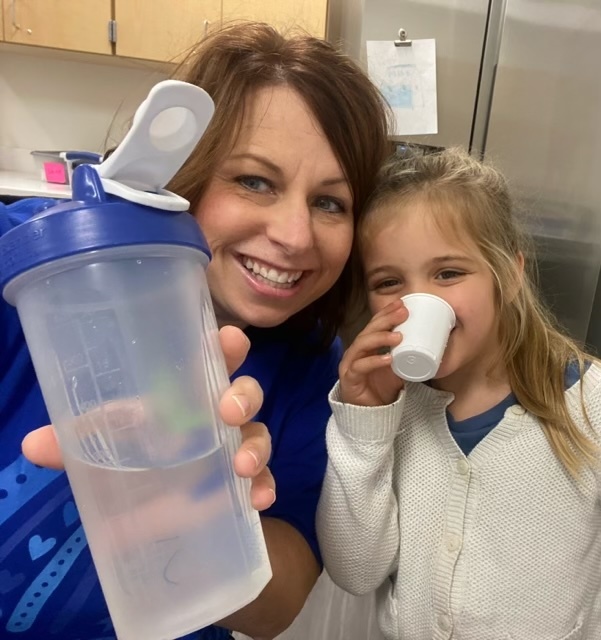
Before Kelly Gillespie ever stepped into a school's health office, the heart of a school nurse was already in her. Kelly spent time early in her career providing health education in area schools. Along the way, she found herself surrounded by educators who met students exactly where they were. Watching teachers teach, encourage, and forge meaningful relationships sparked something in her. She wanted to be part of that.
Her journey unfolded naturally from there; she got to blend her love for education, passion for health, and human connection. Kelly says, “Becoming a school nurse has allowed me to do exactly what inspired me in the first place—be present, build relationships, and support students, their families, and staff in ways that genuinely matter.”
Kelly first discovered her love for nursing at Scott Community College (Bettendorf, IA), later earning her BSN from Upper Iowa University (Fayette, IA). For the past nine years, she has served as a school nurse for Muscatine Community School District (Muscatine, IA), building a career rooted in connection and care.
She thrives on moments with students—listening to their stories, celebrating their progress, and watching confidence bloom in real time. Those small daily interactions have become the foundation of her career culminating into a big impact and earning her the December 2025 Iowa School Mental Health Hero of the Month award.
Along the way, Kelly discovered just how deeply mental health affects students and their ability to grow and learn. Through her daily interactions and the connections, she formed with students and staff. She began to see that an “upset stomach” often points to challenges much deeper than it seems. Kelly has seen firsthand the powerful difference a steady, supportive presence can make.
“We are thankful for Nurse Kelly because she upholds our attendance policies and isn’t afraid to have the tough conversations with parents and students to ensure they’re in school each day,” said Stephanie Zillig, Principal of Madison Elementary School (Muscatine Community School District, IA).
Additionally, Kelly is an advocate and champion for staff. She has created staff fitness groups to encourage teachers to prioritize their mental health and well-being and will send workouts, water challenges, and stress relief tips. Another example of how Kelly supports the staff is leading a book study on Jonathan’s Haidt’s Anxious Generation.
Currently, Kelly is leading a small staff wellness group to help with burnout over the holidays and inspire healthy habits. She has learned that it can be challenging to take care of others if you aren’t taking care of yourself.
Read about Kelly's advice, useful tips, and insights in the Q&A below.
When you think about mental health in schools, what role do school nurses play?
When we think about mental health in schools, school nurses play a vital and often under-recognized role. We are frequently the first point of contact for students, as many will initially present with physical symptoms that may be more. For example, something as simple as an upset stomach can signal much more.
Because of this, school nurses are in a unique position to ask thoughtful, supportive questions that help students explore what they may be experiencing beneath the surface. We collaborate within a multi-tiered system of support (MTSS), coordinating not only physical care but also mental and behavioral health services. This collaboration extends beyond the school walls—connecting families with community resources to ensure continuity of care and meaningful follow-up.
Ultimately, our work is grounded in building strong, trusting connections with both students and their families, helping to create a supportive environment where the child can thrive.
What does supporting mental health look like in your day-to-day work as a school nurse?
Supporting mental health in my day-to-day work as a school nurse really centers on building genuine connections with students and their families. I focus on being fully present listening to them, validating their feelings, and reminding them that no one is expected to be perfect. I work to create positive interactions and compassionate behavior so students can see what it looks like to navigate challenges in a healthy way.
I try to normalize the idea that it’s okay to make mistakes and that what truly matters is how we choose to show up the next time. Encouraging a growth mindset is a big part of this: lots of cheerleading, positive affirmations, and helping students recognize their strengths. My goal is to support them as they learn to grow, adapt, and accept where they are in the moment—while understanding that this moment does not define their future.
What strategies or approaches do you use to help students feel safe and supported?
I allow them the space to regulate first, and I work to be a steady, calm presence. I remind myself to slow down, truly listen, and avoid jumping in to “fix” things right away—sometimes what people need most is simply to be heard.
I validate their feelings, show empathy, and ask open-ended questions to help them explore what they’re experiencing without pressure. I also make sure to follow up afterward, so they know the support doesn’t end when the moment does.
What is the biggest mental health need you see among students or staff right now?
Stress and burnout, anxiety, screen time, and how to find that balance.
How do you integrate mental health awareness or preventative coping strategies into your interactions with students?
By working closely with our school counselor and environmental coach, we can discuss what they are working on within the classroom, so I can then share those strategies with our students during my daily interactions. For example, I now have a positive affirmation sheet in my office to assist students to start their day off on a positive note. Coping strategies include providing a quite safe, calming space, and going through grounding techniques taught to me by social emotional training we have received and collaborating with our environmental coach and school counselor.
Can you share a story—without identifying details—of a time you felt particularly proud of the difference you made for a student or staff member?
There have been many times when students have entered the health office carrying far more physical symptoms. One student in particular stand out—a student who didn’t need medical care as much as they needed a caring adult who would simply listen. In that moment, the shift from fear to relief, from silence to being heard, became one of those quiet victories that stays with you. It reminded me that the biggest difference we make isn’t always in treating physical conditions; sometimes it’s in offering a safe space where a student can finally share what’s really going on.
A couple of years later, that same student reached out and sent me a message I will never forget:
“I’m not sure if you ever doubt it or not, but the impact you’ve made on me, and my life is incredible and something that still affects me daily. I had a lot going on during the time of high school and immediately after, and you were a really big grounding force for me through it all.”
If someone asked you why mental health is just as important as physical health at school, what would you tell them?
Your mind affects everything we do. We can’t be healthy without taking care of not only our physical health but also our mental health. If you are stressed, overwhelmed, or feeling anxious, this can lead to physical symptoms such as headaches, stomachaches, and trouble sleeping. If we can’t process our emotions, then this can cause it to spill over into the classroom, where it can be a challenge to get through the day and impact a person’s overall ability to function in life. Physical wellbeing can’t exist without mental wellbeing and vice versa.
Mental health challenges are often masked. It isn’t always apparent to you; we don’t always know what someone is going through. Mental health can affect your ability to concentrate, your motivation to work, and your physical health. Sometimes that can be misinterpreted as laziness or refusal in our students. For staff who are constantly juggling the demand of teaching responsibilities and student academic performance, this can lead to chronic stress and burnout.
What I would want people to understand is that mental health challenges are real, and we need to take a holistic approach to meet staff and students where they are at that moment. We need to continue educating and working towards structural support in our district to make a difference for our staff, students, and their families.
Know an Iowa K-12 educator, staff member, or student deserving of recognition for their mental health and well-being leadership? Rolling nominations accepted for the Iowa School Mental Health Hero of the Month award!